When I started this blog in 2012, I did it to make sense of my thoughts about starting my first faculty position as an Assistant Professor and to share with a few friends. Never ever I would have thought 1) that I would still be doing this seven years later, 2) that the blog would have more than 500,000 total views, and 3) that I would have become part of a community of science bloggers and Twitter users who supported me scientifically and personally for this long. On a fateful day in 2014 when Melissa @biochembelle tweeted about my posts and introduced me to the scientific community on social media everything changed. I made lots of pocket friends, many of whom became real-life friends, and I was introduced to an extended support network full of information and new ideas, often providing respite from the lonely life of starting a lab on Twitter and via the @NewPI_slack. I met colleagues who were a sounding board for grant ideas and who helped with my career progression and transition (you know who you are). I found Peg AtKisson @iGrrrl who was hired as a grant consultant and was instrumental in helping me get 2 R01s. I watched science Twitter dynamics oscillate between chaotic good and chaotic evil sometimes, and tried my best to tip the scales towards good. I learned a lot about diversity and was inspired to build a more inclusive environment wherever I go. So first of all, thank you!
With the general decline of blogging and the trend toward shorter and more immediate forms of sharing information, I was wondering if this would still be useful, but when I asked 94% of respondents said they would still want a blog. And checking the stats I realized that this site still gets 3-4,000 hits a month despite me not having posted in 10 months...so I will keep going. Since I'm not a new PI any longer and readers asked to focus on mid-career faculty issues, I decided to start a new blog My Mid-career Academic Life. I will try and cross-reference the two blogs at the beginning to get clicks and get indexed and all the necessary internet things, but I didn't want to change the identity of The New PI blog and I prefer to move on. I've been meaning to unpseud for a while, but today is not the day and I promise it will be soon (-ish).
In following @drugmonkeyblog's tradition to list the posts of the month at the end of each year, I decided to link 12 posts to close this blog: the 6 most read and 6 favorite ones which may not have had as much attention. Here we go.
Greatest hits:
1) Submitting your R00 proposal to transfer your K99 to your new job: a survival guide - 12,547 hits as of today. I'm so happy this has been helpful for so many of you!
2) Interviewing for a postdoc: questions you should ask - 11,176 hits. This was for the trainees.
3) A compilation of K99 and R00 advice - 10,890 hits. This links to a lot of my other K99/R00 posts and other blogs/articles that could be useful in the process. I may skip some other popular K99 posts because they're all included here.
4) Where do you find grant money for your lab? - 5,939 hits. This is old and has not been updated in a while, but it's still a good starting list.
5) Tales of postdocs past: what did I learn? - 5,638 hits. Cultivating or identifying resilience in trainees is something faculty discusses ad nauseam and this was one of the first times I articulated some thoughts on finding the right lab peeps.
6) Will I have jumped the glass cliff in 5 years? - 5,554 hits. Looks like the answer to that question is NO, but this was definitely one of my most emotional posts and it struck a chord with many people.
My personal faves:
1) The New PI hits the 6 month slump: how do you keep proactive? - The first 6 months of a faculty position are so hard! Whenever I bump into friends at conferences who have just started a lab, I think of this post and I just want to hug them.
2) Musings about work ethics and an unstructured schedule - I still stand by this one.
3) Is resilience the name of the game in academia? - Yes, it is. Happy to report that yours truly, Doc Becca and my nameless friend in this post are all Associate professors and NIH funded.
4) The beginning of the R01 twin strategy - This sounded crazy and controversial and it kind of worked...not as I intended because they ended up being Irish twins. But yay, twins!
5) In the belly of the beast. NIH Early Career Reviewer - Part 2 of a two-part post on the NIH ECR program. What I learned about NIH review in my first experience is still helping me now that I've been Reviewer 1.
6) Deciding which university is the right fit for you - A more recent and mature post on how to decide which environment you want to be in and how to find it.
So long, and thank you for all the fish! 🐬🐬
Showing posts with label Grant writing. Show all posts
Showing posts with label Grant writing. Show all posts
Thursday, December 26, 2019

Saturday, December 22, 2018
Is resilience the name of the game in academia? Part 3: Sophie is keeping both her kids, b!tches!
A year ago I wrote about the struggle to keep different projects going in my lab. I've been working on two separate and related lines of work that fit into the grander scheme of my lab. I like variety, and started with one scientific identity and then developed another. I kept both projects funded through my postdoc and at the beginning of my independent career, but it has been hard to keep them going lately.
Everyone was telling me to drop my original work and focus on the new one. Maybe it's silly, but it felt much like a failure. So, I threw a Hail Mary and pushed as hard as I could to sent out both R01 grants back to back...not quite twins in the same cycle as in my original plan to go for two R01s as a new investigator, but Irish twins. You see, if you submit as a New Investigator (NI), your grant remains in the NI pile for review even if the previous one was funded. I really wanted to make sure I sent something to the NIH in February because I heard that magical things happen in September/October when the fiscal year ends.
I almost didn't make it.
The grant just wasn't gelling and everyone's recommendations were going against my instincts. I decided to trust the coaching I was getting from colleagues in the field, and follow my PO's suggestions. If my PO had to choose to push for this grant, he needed to see that I listened to his advice. By the end, I was so exhausted, confused, and dejected waiting for the previous R01 to get reviewed on the same day the new R01 was due. One of my friends had to come to stay with me and watch me write. For a while, I didn't look at the grant after I submitted it. I wasn't sure if it was just word salad.
Then everything turned around. I found that the first R01 was going to be funded in the Spring. In July the second R01 was scored 1% from the payline! The NIH said that wasn't good enough, and I put on my big girl pants for the resubmission as an established investigator. But then, in an FY18 rebudgeting miracle the payline was changed! I didn't need to resubmit! And now everything will be funded again. I can't even express the joy at the idea of the science that we will get to do. The sense of wholeness and possibility.
I love and hate the emotional rollercoaster that comes with this job. But now I have 5 more years to keep going and do some very fun science. As we approach the holiday season I have been so thankful for this twist of fate, for my lab, for all others who have helped and supported me. It took a while to internalize this success after so many years of struggles, but there's a light at the end of the tunnel. And now I get to have fun at my job again!
I wish that 2019 will bring the same joy and awesome science to all of you.
Everyone was telling me to drop my original work and focus on the new one. Maybe it's silly, but it felt much like a failure. So, I threw a Hail Mary and pushed as hard as I could to sent out both R01 grants back to back...not quite twins in the same cycle as in my original plan to go for two R01s as a new investigator, but Irish twins. You see, if you submit as a New Investigator (NI), your grant remains in the NI pile for review even if the previous one was funded. I really wanted to make sure I sent something to the NIH in February because I heard that magical things happen in September/October when the fiscal year ends.
I almost didn't make it.
The grant just wasn't gelling and everyone's recommendations were going against my instincts. I decided to trust the coaching I was getting from colleagues in the field, and follow my PO's suggestions. If my PO had to choose to push for this grant, he needed to see that I listened to his advice. By the end, I was so exhausted, confused, and dejected waiting for the previous R01 to get reviewed on the same day the new R01 was due. One of my friends had to come to stay with me and watch me write. For a while, I didn't look at the grant after I submitted it. I wasn't sure if it was just word salad.
Then everything turned around. I found that the first R01 was going to be funded in the Spring. In July the second R01 was scored 1% from the payline! The NIH said that wasn't good enough, and I put on my big girl pants for the resubmission as an established investigator. But then, in an FY18 rebudgeting miracle the payline was changed! I didn't need to resubmit! And now everything will be funded again. I can't even express the joy at the idea of the science that we will get to do. The sense of wholeness and possibility.
I love and hate the emotional rollercoaster that comes with this job. But now I have 5 more years to keep going and do some very fun science. As we approach the holiday season I have been so thankful for this twist of fate, for my lab, for all others who have helped and supported me. It took a while to internalize this success after so many years of struggles, but there's a light at the end of the tunnel. And now I get to have fun at my job again!
I wish that 2019 will bring the same joy and awesome science to all of you.
Friday, February 9, 2018
Is the resilience the name of the game in academia? Part 2. The Aftermath.
Is resilience the name of the game in academia? was the title of a very popular post from last year which opened a wide discussion on how much can one suffer through federal grant applications before they are deemed worthy, and whether the tenure track process is a pyramid scheme.
A couple of weeks ago I was working on my 7th consecutive NIH application and doing the obligatory chat with the NIH Program Officer who could take it in his portfolio. After the discussion he said "I looked up your application record. You are doing exactly what you are supposed to do. Keep going!" I was on the phone so I could roll my eyes. I thought "If someone tells me to keep going one more time, I'm going to to lose it." But what else can you do?
So, I kept going, through the emotional turmoil of working on application #7 while #6 was being reviewed (the NIH running wheel). As I was checking on eRA Commons that the new application was OK, the score for #6 came in...5.0 percentile...Wait. What?! I had to do a double take and make sure it was 5 and not 50. Single digit %. I broke down in tears. The score is well within the pay line and doesn't require any New Investigator bump or special treatment. My PO replied to my email with "Congratulations!"
I am happy, but the tension from running on the wheel for 3 years started dropping and I mostly feel so so tired. The enormity of what happened has still not entirely hit me. The possibilities, the change in focus for a lab that has been just pushing to get one more piece of preliminary/feasibility data, not being afraid that I could not keep the lab alive for more than 6 months...
I started thinking of what I learned from all this and what I could tell others in the same situation I was in. So here it goes.
1) Accept coaching. I remember reading this New Yorker piece by Atul Gawande about always needing a coach to truly become great. Coaching is more than mentoring. A coach identifies your weak spots and tells you how to improve, pushing you beyond what your comfort zone. Seek the people who will look at your grants and your writing and who will rip them open. Anyone who says "This is great" is not helping you. A coach is also someone who knows how to point you in the right direction. Reading my good grant some of my senior mentors said "You finally cracked the language you need to use for the NIH". Yet, they had not been able to tell me how to do it in previous applications and I had to look for professional grant coaching with Peg AtKisson @iGrrrl. So in a society where everyone needs to be praised, actively seek criticism and embrace it. Look for the people who really give you their honest feedback either gratis or for a fee.
2) Take all advice with a grain of salt. Ah, here I'm going to mess with you. You should take coaching and mentoring, but even the best coaches make mistakes. Your ideas are unique to you, as is your individual situation. You are the only one who can make the final decision on what goes into a project, a paper, and a grant proposal. While you should request a lot of feedback to see how different people react to your writing, this will mean a cacophony of different opinions. It is up to you to judge what is useful and what is not. And this is by far the most difficult aspect of being a leader: sticking to your guts, your choices, and your vision. The way I look at it is that if I have to drive my career into the ground, it will be on my own terms.
3) Be nimble. Rapidly adjust to situations and events as they happen. My first R01 application didn't work out and my PO recommended I write something else to target a different study section, so I did. If you are on a short 6-yr clock like me, time is of the essence. If you take 2-3 years to beat a dead horse...or rather to try and raise a cute little foal into a race-horse, you may end up with a project that is still not quite there. If you are in a place where you need two R01s for tenure, forget it! Some if the advice I got was to have multiple projects cooking and also figure out how to constantly repackage a proposal for different funding sources. That's what I call "application Tetris", where you can take one aim from here, one from there and voila', you have a new grant proposal! There is no single way to do things, mostly because you never know what is going to be a hit with reviewers.
4) Keep going! You know this was coming. Resilience is the name of the game. I have often wondered about how to keep going. This job has the ability to drag me back in on the exact moment I am ready to give up. You have probably heard many stories of people who were ready to quit and then everything turned out. I think there is an element in there of your colleagues throwing you a bone. Sometimes study sections appear to be like air-traffic control for young investigators: there are so many in the air, that they want to make sure you are running out of fuel before they let you land and refill. Maybe there is clarity that comes when you are truly desperate that makes you write your best proposals. I don't know.
The last think I can say is 5) Take care of yourself. Nothing is worth your health and well-being. I wish I practiced what I preach, but I'm working on it 😉
A couple of weeks ago I was working on my 7th consecutive NIH application and doing the obligatory chat with the NIH Program Officer who could take it in his portfolio. After the discussion he said "I looked up your application record. You are doing exactly what you are supposed to do. Keep going!" I was on the phone so I could roll my eyes. I thought "If someone tells me to keep going one more time, I'm going to to lose it." But what else can you do?
So, I kept going, through the emotional turmoil of working on application #7 while #6 was being reviewed (the NIH running wheel). As I was checking on eRA Commons that the new application was OK, the score for #6 came in...5.0 percentile...Wait. What?! I had to do a double take and make sure it was 5 and not 50. Single digit %. I broke down in tears. The score is well within the pay line and doesn't require any New Investigator bump or special treatment. My PO replied to my email with "Congratulations!"
I am happy, but the tension from running on the wheel for 3 years started dropping and I mostly feel so so tired. The enormity of what happened has still not entirely hit me. The possibilities, the change in focus for a lab that has been just pushing to get one more piece of preliminary/feasibility data, not being afraid that I could not keep the lab alive for more than 6 months...
I started thinking of what I learned from all this and what I could tell others in the same situation I was in. So here it goes.
1) Accept coaching. I remember reading this New Yorker piece by Atul Gawande about always needing a coach to truly become great. Coaching is more than mentoring. A coach identifies your weak spots and tells you how to improve, pushing you beyond what your comfort zone. Seek the people who will look at your grants and your writing and who will rip them open. Anyone who says "This is great" is not helping you. A coach is also someone who knows how to point you in the right direction. Reading my good grant some of my senior mentors said "You finally cracked the language you need to use for the NIH". Yet, they had not been able to tell me how to do it in previous applications and I had to look for professional grant coaching with Peg AtKisson @iGrrrl. So in a society where everyone needs to be praised, actively seek criticism and embrace it. Look for the people who really give you their honest feedback either gratis or for a fee.
2) Take all advice with a grain of salt. Ah, here I'm going to mess with you. You should take coaching and mentoring, but even the best coaches make mistakes. Your ideas are unique to you, as is your individual situation. You are the only one who can make the final decision on what goes into a project, a paper, and a grant proposal. While you should request a lot of feedback to see how different people react to your writing, this will mean a cacophony of different opinions. It is up to you to judge what is useful and what is not. And this is by far the most difficult aspect of being a leader: sticking to your guts, your choices, and your vision. The way I look at it is that if I have to drive my career into the ground, it will be on my own terms.
3) Be nimble. Rapidly adjust to situations and events as they happen. My first R01 application didn't work out and my PO recommended I write something else to target a different study section, so I did. If you are on a short 6-yr clock like me, time is of the essence. If you take 2-3 years to beat a dead horse...or rather to try and raise a cute little foal into a race-horse, you may end up with a project that is still not quite there. If you are in a place where you need two R01s for tenure, forget it! Some if the advice I got was to have multiple projects cooking and also figure out how to constantly repackage a proposal for different funding sources. That's what I call "application Tetris", where you can take one aim from here, one from there and voila', you have a new grant proposal! There is no single way to do things, mostly because you never know what is going to be a hit with reviewers.
4) Keep going! You know this was coming. Resilience is the name of the game. I have often wondered about how to keep going. This job has the ability to drag me back in on the exact moment I am ready to give up. You have probably heard many stories of people who were ready to quit and then everything turned out. I think there is an element in there of your colleagues throwing you a bone. Sometimes study sections appear to be like air-traffic control for young investigators: there are so many in the air, that they want to make sure you are running out of fuel before they let you land and refill. Maybe there is clarity that comes when you are truly desperate that makes you write your best proposals. I don't know.
The last think I can say is 5) Take care of yourself. Nothing is worth your health and well-being. I wish I practiced what I preach, but I'm working on it 😉
Friday, December 15, 2017
Is "go big or go home" the way to go in academic publishing?
For the past few years, I have been struggling to reconcile my tendency to build large complete stories for publication and the need to show productivity for grants and promotion. I have agonized about what would be a manuscript that would satisfy both requirements, while I had to contend with deadlines, reviewer requests, delays, and personnel leaving. I am still not sure of what is the right way...or if even a right way exists, so I thought I'd brainstorm this here and see what people think.
I was trained to build substantial mechanistic stories so that a phenomenon would be reported with a mechanism attached to explain it. But these take time. I was also trained, maybe naively, to follow the most interesting question and identify whatever approach was most suited to answer it, which has led me to use an array of approaches and not to be technically specialized. This takes even more time. When you are in a large lab with massive resources in an institution with all kinds of expertizes you can draw from, this is greatly intellectually stimulating and a lot of fun. When you are in a small place where you are the only person doing what you are doing, and sometimes the only person in your entire scientific discipline, suddenly this approach is not working so well.
I had to learn this the hard way applying for funding when reviewers couldn't quite place me and
questioned my qualifications to perform techniques I've been using for years. Despite having worked on a particular approach for a long time, I wasn't as prolific in publishing about it since I was building a larger story, and reviewers didn't believe I could do it. So I put a portion of the story together and published it, but they still said it wasn't enough. I looked at what I had, at my submission deadlines, and decided to break things apart a bit more. It broke my heart a little as I was cannibalizing another paper in progress to break it into smaller "single approach" pieces. Now, while I write yet another paper, which relies on some of the previously published data, I so wish I had kept everything together! It would have been so beautiful and cohesive, and now I have to do somersaults to make my point. There is another paper which has been in the works for 10 years now (yup, ten) because we have been learning new techniques which are taking years to perfect, and I wonder if it will be worth it.
I watch people who stuck it out and built one of these beautiful and cohesive mechanistic stories and I have to admit I am a little envious. Not necessarily because of the high-impact paper and the admiration of their peers, but because of the pride that comes with having a great piece of work to call your own. In giving a talk I can still place all the smaller pieces into a bigger picture. Yet, I cannot tell if it is as evident for others such as study section members, search committees, and university administrators, to see. In the end, my belief has always been that one has to strike the right balance between publishing a large story and not taking too long to do it and risk appearing unproductive. I still have not figured out how to walk this tightrope...
I was trained to build substantial mechanistic stories so that a phenomenon would be reported with a mechanism attached to explain it. But these take time. I was also trained, maybe naively, to follow the most interesting question and identify whatever approach was most suited to answer it, which has led me to use an array of approaches and not to be technically specialized. This takes even more time. When you are in a large lab with massive resources in an institution with all kinds of expertizes you can draw from, this is greatly intellectually stimulating and a lot of fun. When you are in a small place where you are the only person doing what you are doing, and sometimes the only person in your entire scientific discipline, suddenly this approach is not working so well.
 |
| Image: Adi Holzer, via Wikimedia Commons |
questioned my qualifications to perform techniques I've been using for years. Despite having worked on a particular approach for a long time, I wasn't as prolific in publishing about it since I was building a larger story, and reviewers didn't believe I could do it. So I put a portion of the story together and published it, but they still said it wasn't enough. I looked at what I had, at my submission deadlines, and decided to break things apart a bit more. It broke my heart a little as I was cannibalizing another paper in progress to break it into smaller "single approach" pieces. Now, while I write yet another paper, which relies on some of the previously published data, I so wish I had kept everything together! It would have been so beautiful and cohesive, and now I have to do somersaults to make my point. There is another paper which has been in the works for 10 years now (yup, ten) because we have been learning new techniques which are taking years to perfect, and I wonder if it will be worth it.
I watch people who stuck it out and built one of these beautiful and cohesive mechanistic stories and I have to admit I am a little envious. Not necessarily because of the high-impact paper and the admiration of their peers, but because of the pride that comes with having a great piece of work to call your own. In giving a talk I can still place all the smaller pieces into a bigger picture. Yet, I cannot tell if it is as evident for others such as study section members, search committees, and university administrators, to see. In the end, my belief has always been that one has to strike the right balance between publishing a large story and not taking too long to do it and risk appearing unproductive. I still have not figured out how to walk this tightrope...
Monday, May 29, 2017
A scientific Sophie's Choice
One of my mentors once said that women have a harder time letting projects go. Both as it relates to the level of perfection that needs to be achieved to publish and to the general attachment to an idea that keeps resurfacing over the years. Right now, I am struggling with the decision of whether to let a project go.
If you have not seen or read Sophie's Choice, it's worth it. Meryl Streep is amazing in it and she won an Oscar. Sophie is a Polish woman captured by the Nazis with her two children. As she enters Auschwitz she has to decide which one of her children will die. Which one will be more likely to survive the camp? Which one is the weakest needing more protection? Which one is the favorite? I have written many times of how my lab is split between two major projects, of how they are different in many ways, which is messing with my identity as a scientist. In addition, while they both were funded, one project has been struggling from the start and has required a huge amount of my attention and effort. The right people to carry it on have not materialized, so I have kept it going mostly by myself by sheer willpower and elbow grease. As I make the final tenure push, I have to decide whether to let it go. This feels like cutting out a piece of myself. This is the project that got me my job. It's the one that was my pride and joy as a postdoc, the one that made a beautiful job talk, and the one that was supposed to support my independent lab for years to come. It was not supposed to falter. It taught me that no matter how many brilliant ideas you have, your environment and your hires are critical for success. It required infrastructure that did not exist where I am and that had to be built from scratch without the proper support. It required equipment that was not available. Some major senior faculty stakeholders left to pursue other opportunities, collaborators who signed up to help did not deliver on their parts of the work. Funding runs out in a few months. The reviewers of the R01 application based on this work thought the hypothesis was interesting, but they wanted me to prove it. Which I cannot do without more money. So there. All in all, over four years we are talking of an investment of around $800K and I have to decide how much more time and money I really want to devote to it. The seed fell on ground that was not fertile enough for it to grow quickly.
The other child had been the recalcitrant one. Uncooperative and slow to develop, but it brought in money, so I kept it. I added it almost as an afterthought in my job talk, because I had a freaking K99 on it, so it would have looked weird if I ignored it. Opposite to the first one, this project required all my attention during my postdoc without much reward. Now the duckling has morphed into the most beautiful swan and we have three major papers in the pipeline. Because of the multiple personnel losses last summer, it stalled for six months and is now picking up again with new talented postdocs. My mentors tell me to cut my losses and go all in with this second project. Focus on getting the papers out to make this become my sure bet for an R01. Yet, I have come to my faculty position with an identity and a hypothesis I have been pursuing for 10 years, and I am faced with forsaking it. My gut is confused. I do not have the luxury of time to figure things out. In less than one year I have to start assembling my tenure package and I need an R01 to survive. I love both my projects, I have poured so much of myself in them. But the funding is what it is and I have to be savvy. My biggest conundrum is whether savvy means relying on a strong track record or on a really snazzy idea. I can write a new boring R01 on project 1 on things I am proven to know how to do, or I can continue to pursue the very exciting project 2 where study sections are permanently worried about my expertise. I can't decide...
If you have not seen or read Sophie's Choice, it's worth it. Meryl Streep is amazing in it and she won an Oscar. Sophie is a Polish woman captured by the Nazis with her two children. As she enters Auschwitz she has to decide which one of her children will die. Which one will be more likely to survive the camp? Which one is the weakest needing more protection? Which one is the favorite? I have written many times of how my lab is split between two major projects, of how they are different in many ways, which is messing with my identity as a scientist. In addition, while they both were funded, one project has been struggling from the start and has required a huge amount of my attention and effort. The right people to carry it on have not materialized, so I have kept it going mostly by myself by sheer willpower and elbow grease. As I make the final tenure push, I have to decide whether to let it go. This feels like cutting out a piece of myself. This is the project that got me my job. It's the one that was my pride and joy as a postdoc, the one that made a beautiful job talk, and the one that was supposed to support my independent lab for years to come. It was not supposed to falter. It taught me that no matter how many brilliant ideas you have, your environment and your hires are critical for success. It required infrastructure that did not exist where I am and that had to be built from scratch without the proper support. It required equipment that was not available. Some major senior faculty stakeholders left to pursue other opportunities, collaborators who signed up to help did not deliver on their parts of the work. Funding runs out in a few months. The reviewers of the R01 application based on this work thought the hypothesis was interesting, but they wanted me to prove it. Which I cannot do without more money. So there. All in all, over four years we are talking of an investment of around $800K and I have to decide how much more time and money I really want to devote to it. The seed fell on ground that was not fertile enough for it to grow quickly.
The other child had been the recalcitrant one. Uncooperative and slow to develop, but it brought in money, so I kept it. I added it almost as an afterthought in my job talk, because I had a freaking K99 on it, so it would have looked weird if I ignored it. Opposite to the first one, this project required all my attention during my postdoc without much reward. Now the duckling has morphed into the most beautiful swan and we have three major papers in the pipeline. Because of the multiple personnel losses last summer, it stalled for six months and is now picking up again with new talented postdocs. My mentors tell me to cut my losses and go all in with this second project. Focus on getting the papers out to make this become my sure bet for an R01. Yet, I have come to my faculty position with an identity and a hypothesis I have been pursuing for 10 years, and I am faced with forsaking it. My gut is confused. I do not have the luxury of time to figure things out. In less than one year I have to start assembling my tenure package and I need an R01 to survive. I love both my projects, I have poured so much of myself in them. But the funding is what it is and I have to be savvy. My biggest conundrum is whether savvy means relying on a strong track record or on a really snazzy idea. I can write a new boring R01 on project 1 on things I am proven to know how to do, or I can continue to pursue the very exciting project 2 where study sections are permanently worried about my expertise. I can't decide...
Wednesday, February 15, 2017
In the belly of the beast. NIH Early Career Reviewer Part 2: meeting
In a recent post I went through some of the benefits of the NIH Early Career Reviewer program, which was developed by the Center for Scientific Review (CSR) to train scientist with no previous NIH experience in the NIH review process. I was accepted into the program last year and just participated in my first study section meeting.
To preserve full confidentiality the NIH doesn't allow reviewers to speak of the proposals or the discussion outside of the grant discussion itself, even among each other, so there will be not details divulged or even specific references. The CSR has some excellent videos and tutorials in their applicant resource page and the discussion process is pretty much as shown in this video. Briefly, each application is assigned to three reviewers. Reviewers state their initial scores, then reviewer 1, the primary reviewer, sets the tone by summarizing the application and stating their critiques, then reviewers 2 and 3 can add their comments. If there is variation in the scores, as shown in the video, the discussion can focus on specific points and all members of the study section can chime in and ask questions or add comments. At the end of the discussion the chair summarizes the comments and the primary reviewers can confirm or change their scores. Their scores set the range for all other reviewers to vote, but anyone can choose to vote outside the range (above or below) as long as their declare their intention to do so. And that's how an NIH score is born.
It was a fascinating and eye-opening process and what I can say will reiterate what has been said to me. But these concepts were really driven home by the experience.
1) Study sections can be VERY DIFFERENT from each other: they have a specific focus and specific expertise, which fluctuates depending on the members and whether there are power groups. Part of the SROs job is to balance things out since study sections change or merge depending on how research progresses, but it may not always work. Knowing your study sections can go a long way for finding the right fit. I spoke to several people about their experience in different study sections and they knew that there were places where they wouldn't get funded.
- Look up the standing members. Do you know who they are? Are they people in your field?
- Go to NIH Reporter and look up the grants they funded in the past few cycles. READ the summaries. Do not just assume that because there was one grant that kind of sounds like yours, it would be a good fit.
2) If you truly think you are in the wrong place, move heaven and earth to MOVE YOUR GRANT. Make a request and justify it. Ask for advice from senior people. You can literally be Not Discussed from one group and funded from another. It is again a question of fit because the right people will have the expertise to understanding why your work in important and how it fits in the field. Excitement about the problem can go a long way to rescue a proposal with grantsmanship issues.
- Call the SRO, call the CSR. Get out.
3) Take a STEP BACK and look at your grant from the prospective of an educated tax payer or a science journalist. Why is this exciting? How will giving you money make the world better? Why should people be reading your work? Your reviewers will be good scientists, but may not have direct expertise in your specific project. You need to make them see the relevance (Significance), the novelty (Innovation), the sound hypothesis (Premise) and the feasibility (Rigor) of your work. If you hit all the right notes your impact will be high (or in reality as close to 1 as possible). In a funding climate where only 10-15% make it, it's not the question of whether your project is worth it, but rather whether you can make multiple people believe it is WORTHIER than others.
- It's a mantra I wrote down multiple times in my weekly planner for the month "Go big picture! Be clear! Be specific!". Counterintuitive, I know.
4) BE CLEAR! I'll double down on this. By "Be clear" I mean...If it's 5pm, people have been discussing grants for several hours and your Specific aim page is 30% acronyms, therefore not readable, you are at the mercy of the lowest scoring reviewer. If it's 11pm and your reviewer cannot understand how the different molecules in your proposal are connected and how your experiments flow, your impact score may be lower.
- Leave the acronyms and abbreviations for the Approach and even there use them in moderation. Also, don't make new acronyms up.
- Generate as many diagrams and visual aids as possible to drive the message home.
- BE CLEAR! Be so clear that the undergrad in your lab gets it.
5) BE RESPONSIVE, DON'T BE A JERK. This seems like a given, but I think people have gotten used to pushing back to editors and reviewers on paper submissions. Suddenly, they'll believe that if you say "I know you told be X, but I don't want to do it and I'll do Y". Unless Y is groundbreaking new work, it's not going to fly. Be responsive to reviewers' comments, you only have one shot at resubmission. As part of the discussion of resubmissions the assigned reviewers have to comment on the steps taken to improve the application. Do not behave like you're too cool for school, because people will not buy it, if the grant does not hold up to scrutiny.
- Do as much as you can to satisfy reviewers' comments and justify things that you couldn't do in the Introduction. It will not necessarily work, but at least your review will not start with people who are annoyed.
As I wrote in the last post, I knew all these things, but for some reason I feel like I didn't. I rushed home to take a long hard look at my grant and make sure that everything was properly framed and explained. At the end you never know. My own grant was reviewed at the same time at a different study section and while I'm usually a basket-case on "study section day", I was much calmer. There was a definite sense of control because I could tell myself "This is what is happening right now to my grant." "This is how people are looking at things." There was also a sense of resignation because of the callousness of the whole process. Not that the reviewers were mean or dismissive, it was a great group and I felt review was deep and fair. It's just that the paylines are so low that you cannot get attached...even if it feels deeply personal for the applicant, whose academic survival may depend on it. If your goal as a reviewer is to be fair and make sure the best grants get funded, it cannot be personal. And that is the topic for a whole new post...
 |
| Detail from Raffaello's The School of Athens with the artist (in white) eavesdropping on reviewers... |
It was a fascinating and eye-opening process and what I can say will reiterate what has been said to me. But these concepts were really driven home by the experience.
1) Study sections can be VERY DIFFERENT from each other: they have a specific focus and specific expertise, which fluctuates depending on the members and whether there are power groups. Part of the SROs job is to balance things out since study sections change or merge depending on how research progresses, but it may not always work. Knowing your study sections can go a long way for finding the right fit. I spoke to several people about their experience in different study sections and they knew that there were places where they wouldn't get funded.
- Look up the standing members. Do you know who they are? Are they people in your field?
- Go to NIH Reporter and look up the grants they funded in the past few cycles. READ the summaries. Do not just assume that because there was one grant that kind of sounds like yours, it would be a good fit.
2) If you truly think you are in the wrong place, move heaven and earth to MOVE YOUR GRANT. Make a request and justify it. Ask for advice from senior people. You can literally be Not Discussed from one group and funded from another. It is again a question of fit because the right people will have the expertise to understanding why your work in important and how it fits in the field. Excitement about the problem can go a long way to rescue a proposal with grantsmanship issues.
- Call the SRO, call the CSR. Get out.
3) Take a STEP BACK and look at your grant from the prospective of an educated tax payer or a science journalist. Why is this exciting? How will giving you money make the world better? Why should people be reading your work? Your reviewers will be good scientists, but may not have direct expertise in your specific project. You need to make them see the relevance (Significance), the novelty (Innovation), the sound hypothesis (Premise) and the feasibility (Rigor) of your work. If you hit all the right notes your impact will be high (or in reality as close to 1 as possible). In a funding climate where only 10-15% make it, it's not the question of whether your project is worth it, but rather whether you can make multiple people believe it is WORTHIER than others.
- It's a mantra I wrote down multiple times in my weekly planner for the month "Go big picture! Be clear! Be specific!". Counterintuitive, I know.
4) BE CLEAR! I'll double down on this. By "Be clear" I mean...If it's 5pm, people have been discussing grants for several hours and your Specific aim page is 30% acronyms, therefore not readable, you are at the mercy of the lowest scoring reviewer. If it's 11pm and your reviewer cannot understand how the different molecules in your proposal are connected and how your experiments flow, your impact score may be lower.
- Leave the acronyms and abbreviations for the Approach and even there use them in moderation. Also, don't make new acronyms up.
- Generate as many diagrams and visual aids as possible to drive the message home.
- BE CLEAR! Be so clear that the undergrad in your lab gets it.
5) BE RESPONSIVE, DON'T BE A JERK. This seems like a given, but I think people have gotten used to pushing back to editors and reviewers on paper submissions. Suddenly, they'll believe that if you say "I know you told be X, but I don't want to do it and I'll do Y". Unless Y is groundbreaking new work, it's not going to fly. Be responsive to reviewers' comments, you only have one shot at resubmission. As part of the discussion of resubmissions the assigned reviewers have to comment on the steps taken to improve the application. Do not behave like you're too cool for school, because people will not buy it, if the grant does not hold up to scrutiny.
- Do as much as you can to satisfy reviewers' comments and justify things that you couldn't do in the Introduction. It will not necessarily work, but at least your review will not start with people who are annoyed.
As I wrote in the last post, I knew all these things, but for some reason I feel like I didn't. I rushed home to take a long hard look at my grant and make sure that everything was properly framed and explained. At the end you never know. My own grant was reviewed at the same time at a different study section and while I'm usually a basket-case on "study section day", I was much calmer. There was a definite sense of control because I could tell myself "This is what is happening right now to my grant." "This is how people are looking at things." There was also a sense of resignation because of the callousness of the whole process. Not that the reviewers were mean or dismissive, it was a great group and I felt review was deep and fair. It's just that the paylines are so low that you cannot get attached...even if it feels deeply personal for the applicant, whose academic survival may depend on it. If your goal as a reviewer is to be fair and make sure the best grants get funded, it cannot be personal. And that is the topic for a whole new post...
Saturday, February 4, 2017
In the belly of the beast. NIH Early Career Reviewer Part 1: review
Last year I applied to the NIH Early Career Reviewer program, which was developed by the Center for Scientific Review (CSR) to train scientist with no previous NIH experience to review grants. It was brought up in a CSR seminar on grant writing and I thought "Why not? It may be a good experience." I was told it helps to identify study sections of interest and reach out to the Scientific Review Officer (SRO) in charge a few months before. I was debating which study sections I could go to, when an SRO emailed me. I was completely confused because I thought the group had hated my grant and that this particular study section was not a good fit for me, but of all the SROs I dealt with this one was the most communicative and helpful, so again "Why not? It may be a good experience."
I have only two words for you: DO IT!! I cannot speak of any of the specifics of the review process, because everyone signs a confidentiality agreement and review secrecy must be respected, but I can speak of things that are available to the public and tell you how this was helpful to me in general terms.
1) First of all, you get to see a lot of grants. It had not dawned on me that you get to see ALL the grants in that study section in that cycle and ALL the critiques as you have to participate in voting on all of them (unless you have a conflict of course). I don't know why it had not clicked that I would get a folder with dozens and dozens of grants, but it was better then Christmas Day.
2) You really understand what that specific study section is about. My application was wrong for them, but now I know exactly what kind of stuff they get. And it isn't a bad fit at all. The grants I received were a good fit for my expertise. I could give useful and cogent critiques. I can totally see sending a grant there in the future, but it will have to be very different from the one I sent them first.
3) You figure out how agonizing it is to judge "impact". How you have to balance all the review criteria and figure out "Is this going to work?" "And if it works, is it going to move the field forward?" It is literally like judging a pointillist painting: you step in to see the brushstrokes, you take five steps back to see how it all comes together. Sometimes you're willing to let go of minor errors for a truly lovely picture, but if it doesn't come together, you don't buy it.
4) You figure out how to judge everything else. You are constantly reminded which criteria are critical. The NIH was not joking when they introduced premise and rigor and sex as a biological variable criteria. Also, your senior colleagues were serious when they told you "You are only allowed to fight for one grant". As special snowflakes, we all think that our grants are brilliant and the reviewers may see beyond minor flaws...they won't. They can't. You can only champion one. 10-15% get funded...so you're looking for the best one and hope other reviewers will like it too. A good average grant gets a 5, a bad grant an 8. Do not take it personally. It's the Hunger Games out there.
5) You get coaching in writing your critiques. As an ECR, you are the official reviewer in training, so you do a bit of extra work and get help from the SRO on what you need to focus on to give effective feedback (not science-wise, but more regarding NIH criteria).
6) Oh right...you get an extension on your grant submission, so that you get to submit your own grant AFTER the regular deadline and likely after you have served on study section. As an ECR you only receive half a grant load, but it is still substantial, so the extension is really needed.
It is truly a great program! If like me you have been struggling to figure out what reviewers want to the point that you can't write any more, this will jolt you out of your paralysis with tons of new ideas. I can't promise it will work, because nowadays there is an element of luck in grant funding that is outside of our control, but it will definitely get you to understand what steps you could take to be in the best possible position. I'll see how the actual meeting goes and whether I can do a Part 2...
I have only two words for you: DO IT!! I cannot speak of any of the specifics of the review process, because everyone signs a confidentiality agreement and review secrecy must be respected, but I can speak of things that are available to the public and tell you how this was helpful to me in general terms.
1) First of all, you get to see a lot of grants. It had not dawned on me that you get to see ALL the grants in that study section in that cycle and ALL the critiques as you have to participate in voting on all of them (unless you have a conflict of course). I don't know why it had not clicked that I would get a folder with dozens and dozens of grants, but it was better then Christmas Day.
2) You really understand what that specific study section is about. My application was wrong for them, but now I know exactly what kind of stuff they get. And it isn't a bad fit at all. The grants I received were a good fit for my expertise. I could give useful and cogent critiques. I can totally see sending a grant there in the future, but it will have to be very different from the one I sent them first.
3) You figure out how agonizing it is to judge "impact". How you have to balance all the review criteria and figure out "Is this going to work?" "And if it works, is it going to move the field forward?" It is literally like judging a pointillist painting: you step in to see the brushstrokes, you take five steps back to see how it all comes together. Sometimes you're willing to let go of minor errors for a truly lovely picture, but if it doesn't come together, you don't buy it.
4) You figure out how to judge everything else. You are constantly reminded which criteria are critical. The NIH was not joking when they introduced premise and rigor and sex as a biological variable criteria. Also, your senior colleagues were serious when they told you "You are only allowed to fight for one grant". As special snowflakes, we all think that our grants are brilliant and the reviewers may see beyond minor flaws...they won't. They can't. You can only champion one. 10-15% get funded...so you're looking for the best one and hope other reviewers will like it too. A good average grant gets a 5, a bad grant an 8. Do not take it personally. It's the Hunger Games out there.
5) You get coaching in writing your critiques. As an ECR, you are the official reviewer in training, so you do a bit of extra work and get help from the SRO on what you need to focus on to give effective feedback (not science-wise, but more regarding NIH criteria).
6) Oh right...you get an extension on your grant submission, so that you get to submit your own grant AFTER the regular deadline and likely after you have served on study section. As an ECR you only receive half a grant load, but it is still substantial, so the extension is really needed.
It is truly a great program! If like me you have been struggling to figure out what reviewers want to the point that you can't write any more, this will jolt you out of your paralysis with tons of new ideas. I can't promise it will work, because nowadays there is an element of luck in grant funding that is outside of our control, but it will definitely get you to understand what steps you could take to be in the best possible position. I'll see how the actual meeting goes and whether I can do a Part 2...
Saturday, September 24, 2016
The emotional toll of the "NIH running wheel"
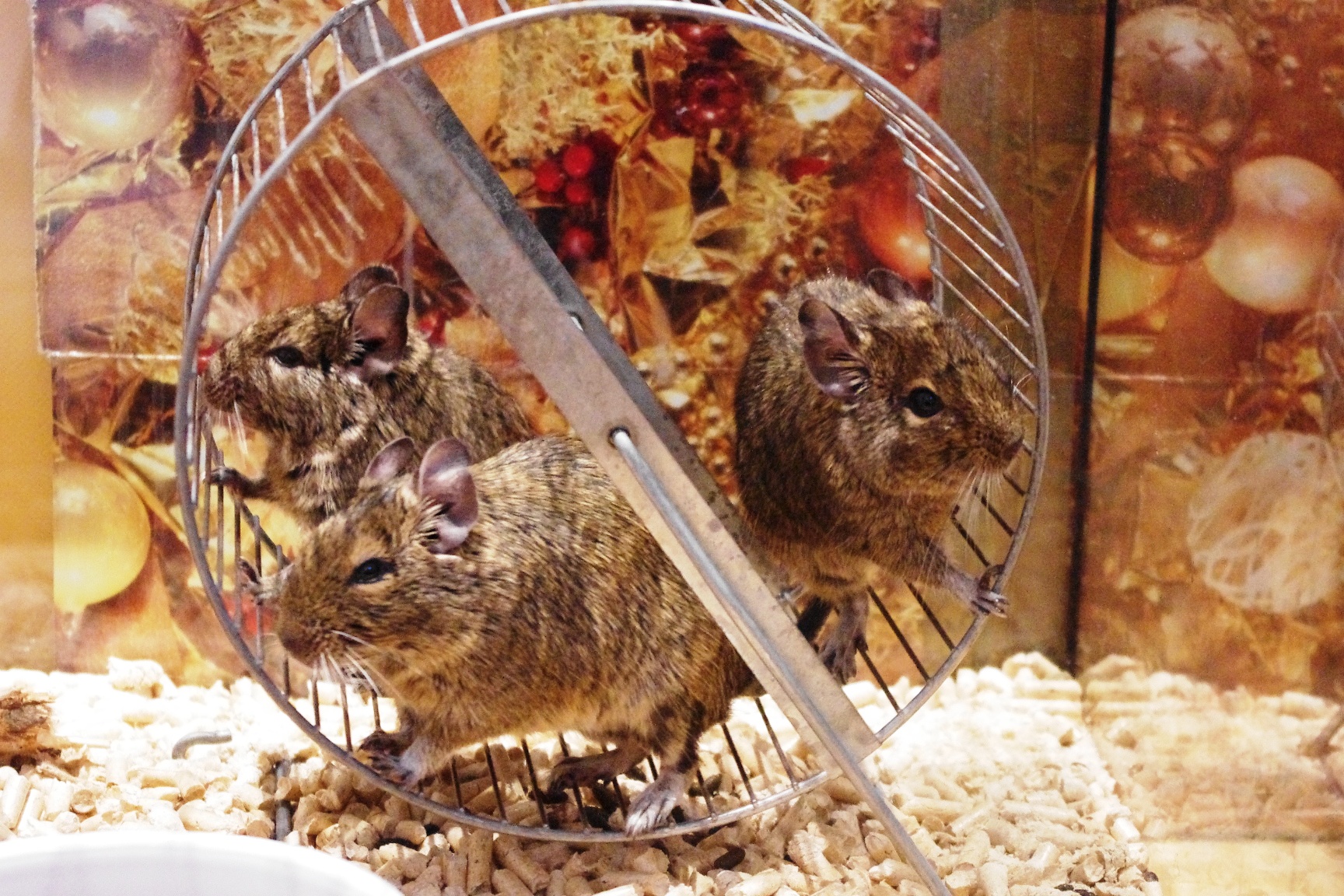
While it's a different cycle, the NIH cycle is as bad as the menstrual one. Especially, if you are on the running wheel of submitting a grant every cycle, which means having a grant reviewed every cycle as you are writing the other one. I haven't quite recovered from the meltdown in June (post here), which was on the heels of the February one, and here comes the October deadline. Last cycle my R01 was due the same day the other R01 was being reviewed. This time I'm on three R21s for October. Yup, you've heard this right. Three. And my R01 is being reviewed at the end of the October. Because for some reason, all my study sections tend to cluster as close as possible to the resubmission date, so that there is no hope I could skip a cycle. As my other funding gets close to the end, and the pressure increases for keeping the lab going, every grant generates more and more anxiety. The more you submit, the more it feels like there is no rhyme or reason and you just have to do your absolute best and hope that your proposal will fall in the right hands. The closer the study section date gets, the more you start second guessing what you have already sent in and you find all the flaws in your mind. Positive thinking and negative thinking run a strange relay in your head, when you want to believe the grant will be funded, but you want to prepare yourself for the worst at the same time, so you kind of go for the middle ground "All I want is a score!" I hate you running wheel!! (Waving fist to the sky)
So more and more yoga. And maybe I should pick up Transcendental Meditation...or drinking. What I should really be doing now, is writing.
Wednesday, May 4, 2016
Maintaining your ESI status...
With one R01 application waiting for additional experiments before resubmission and one R01 submitted, I received the dreaded email from the NIH saying that my ESI (early stage investigator) status had ended. I was sad and wondered what would happen to my lab that the extra bump in percentile for funding is gone. Since I have never had an R01 the New Investigator status still holds, but it's institute dependent and not as codified as the ESI.
The fact that ESI status depends on the date your PhD was conferred is a real issue as people stay longer and longer in their postdoc position. All candidates we interviewed in our latest faculty search had started their postdocs 2007-2009, so their ESI bump could end as early as next year. I was talking to a friend about this and actually found out that things are not as black and white. With some planning you can maintain your ESI past the dreaded deadline.
It turns out your application is listed as ESI as long as you SUBMIT before the ESI ends, so, phew, my currently submitted R01 will be regarded as ESI-eligible. Not only...
For individuals who are still New Investigators at the time of resubmission of the A1 application, there is a 13 month period during which the New Investigator can submit the A1 resubmission application to retain ESI status.
This means that you have 1 year to resubmit your application and will still maintain ESI status. So, my first R01 application will still be considered ESI if resubmitted in July 2016 AND my second R01 application will remain ESI until March 2017...a full year after my ESI status ended. Of course the ESI advantage will disappear if R01 #1 is funded, but it's nice to know that I have multiple chances. I had no idea that any of this was in place before I started my lab and most of your senior advisors do not know either. But this could be make all the difference in your funding!
The fact that ESI status depends on the date your PhD was conferred is a real issue as people stay longer and longer in their postdoc position. All candidates we interviewed in our latest faculty search had started their postdocs 2007-2009, so their ESI bump could end as early as next year. I was talking to a friend about this and actually found out that things are not as black and white. With some planning you can maintain your ESI past the dreaded deadline.
It turns out your application is listed as ESI as long as you SUBMIT before the ESI ends, so, phew, my currently submitted R01 will be regarded as ESI-eligible. Not only...
For individuals who are still New Investigators at the time of resubmission of the A1 application, there is a 13 month period during which the New Investigator can submit the A1 resubmission application to retain ESI status.
This means that you have 1 year to resubmit your application and will still maintain ESI status. So, my first R01 application will still be considered ESI if resubmitted in July 2016 AND my second R01 application will remain ESI until March 2017...a full year after my ESI status ended. Of course the ESI advantage will disappear if R01 #1 is funded, but it's nice to know that I have multiple chances. I had no idea that any of this was in place before I started my lab and most of your senior advisors do not know either. But this could be make all the difference in your funding!
Monday, February 22, 2016
This is how I will use preprints. How would you use them?
As usual there is some fierce debate going on on Twitter and this time it's about about preprints (non-peer-reviewed manuscripts made publicly available) and how they will save or completely doom biomedical research. Lately I have been thinking a lot about how I would use preprints, as I am writing a couple of papers. Here are my 2 cents.
Pre-prints are NOT peer-reviewed publications and should not be treated as such, but I consider them full fledged scientific output, i.e. items which could legally reside in an NIH biosketch. If you are at the point in a project where you have a fully formed manuscript with figures and stuff, kudos to you! Getting to that stage in a project is an achievement and a preprint in my book is a 1,000 times better than a manuscript listed "in preparation" in your CV. If I am on a faculty search committee or on a grant review panel and you list papers "in prep", that means nothing to me since I have no idea of when those projects will be done, nor what their scope is. I had papers in prep on my CV that never saw the light of day...now I know better. So as a reviewer or committee member I would be delighted to read your preprints. It would allow me to actually take a look at your work.
This brings me to a point that baffles me, that preprints will doom biomedical research because without peer review, how will we judge? If preprints count for grants and job applications, will we not get flooded with crap? Wait, are we suddenly unable to read a paper? Despite all the people screaming to the top of their lungs that peer review is broken, I have always had a great experience as a peer reviewer and a peer reviewee (apart from Nature, reviewers for Nature are crazy, but this is a story from another post). Reviewers of my papers AND my grants have (almost) always had constructive and interesting comments which have led to a greatly improved product. As a relatively new reviewer, I always go read all the other reviewers' comments. In general I find that we agree, and that sometimes they bring up some really smart points is hadn't thought about or I didn't want to raise (I'm usually glad they did). All this to say that as someone who can write and review a paper, I can read a preprint and decide whether it's good or not....and so can most scientists. As long as we agree that a preprint is a manuscript that must be taken with a grain of salt, I think we'll do just fine.
How do I plan to use preprints in my own lab? Judiciously and with caution. Posting a preprint is still a very scary thing for a new investigator. I know there are other groups working on my genes of interest and I know they have some of the reagents/animals I have. They may not quite have the same expertise/ideas we have, but I've been surprised before by papers coming out of left field. Will the preprint of a particularly interesting finding generate wide interest and get multiple groups to actually publish before we do? Am I putting my career in jeopardy?
Some academics think of this attitude as blasphemy, but I look at my lab as it was a business. My products are papers, my earnings are grants. I peddle my goods at conferences and talks, find supporters and collaborators. I was trained to always share openly. If you don't put your product out there, who's going to buy it? It has served me well in the past: I have found my best collaborators by talking openly at conferences and sharing has saved me from getting scooped a couple of times. So I tend to lean towards preprints as just another product. I guess posting one is like beta testing. When I do I will be terrified and anxious, like when I occasionally share my inner fears and insecurities on my blog. But I'll start with baby steps after thorough discussion with my trainees and how this could help/hurt them. Let's just hope my papers don't stay in beta as long as Gmail!
Pre-prints are NOT peer-reviewed publications and should not be treated as such, but I consider them full fledged scientific output, i.e. items which could legally reside in an NIH biosketch. If you are at the point in a project where you have a fully formed manuscript with figures and stuff, kudos to you! Getting to that stage in a project is an achievement and a preprint in my book is a 1,000 times better than a manuscript listed "in preparation" in your CV. If I am on a faculty search committee or on a grant review panel and you list papers "in prep", that means nothing to me since I have no idea of when those projects will be done, nor what their scope is. I had papers in prep on my CV that never saw the light of day...now I know better. So as a reviewer or committee member I would be delighted to read your preprints. It would allow me to actually take a look at your work.
This brings me to a point that baffles me, that preprints will doom biomedical research because without peer review, how will we judge? If preprints count for grants and job applications, will we not get flooded with crap? Wait, are we suddenly unable to read a paper? Despite all the people screaming to the top of their lungs that peer review is broken, I have always had a great experience as a peer reviewer and a peer reviewee (apart from Nature, reviewers for Nature are crazy, but this is a story from another post). Reviewers of my papers AND my grants have (almost) always had constructive and interesting comments which have led to a greatly improved product. As a relatively new reviewer, I always go read all the other reviewers' comments. In general I find that we agree, and that sometimes they bring up some really smart points is hadn't thought about or I didn't want to raise (I'm usually glad they did). All this to say that as someone who can write and review a paper, I can read a preprint and decide whether it's good or not....and so can most scientists. As long as we agree that a preprint is a manuscript that must be taken with a grain of salt, I think we'll do just fine.
How do I plan to use preprints in my own lab? Judiciously and with caution. Posting a preprint is still a very scary thing for a new investigator. I know there are other groups working on my genes of interest and I know they have some of the reagents/animals I have. They may not quite have the same expertise/ideas we have, but I've been surprised before by papers coming out of left field. Will the preprint of a particularly interesting finding generate wide interest and get multiple groups to actually publish before we do? Am I putting my career in jeopardy?
Some academics think of this attitude as blasphemy, but I look at my lab as it was a business. My products are papers, my earnings are grants. I peddle my goods at conferences and talks, find supporters and collaborators. I was trained to always share openly. If you don't put your product out there, who's going to buy it? It has served me well in the past: I have found my best collaborators by talking openly at conferences and sharing has saved me from getting scooped a couple of times. So I tend to lean towards preprints as just another product. I guess posting one is like beta testing. When I do I will be terrified and anxious, like when I occasionally share my inner fears and insecurities on my blog. But I'll start with baby steps after thorough discussion with my trainees and how this could help/hurt them. Let's just hope my papers don't stay in beta as long as Gmail!
Tuesday, February 9, 2016
Not all R01s are created equal. When should you let a project go?
The second R01 is done and it was very different from the first one.
The first one was very hard to write, in the sense that the choice of what was going to be in it, what the flow of the experiments was going to be, and how to properly balance the aims was difficult. I took into account opinions from many readers, mostly on the Specific Aims, and worked it and reworked it for almost four months. Some thoughts here. It was discussed, scored poorly. Comments from everyone were very positive about the structure of the grant, but not the writing and the feasibility. My lab is working on all feasibility issues and the proposal will go in again as soon as we are ready.
The second one was not too hard to write, the flow is simple and logical, because the flow of that project has always been simple. However, putting it all together was a nightmare that took months and months of coaxing collaborators to provide preliminary data and information, getting permissions and accesses to patients, and just coordinating multiple moving pieces. It was the first time I had to delegate a part of the writing to other people. The structure was laid out as early as February of last year, but by October we were still not there. Since most of the writing was done over the holiday break and at the beginning of the semester nobody apart from my lab and my collaborators read it, so I had no external feedback. I based my tone and amount of detail in the approach based on the comments I had for R01 #1, but this will go to a different institute and a different study section. To a study section I don't know and with whom nobody I know has anything to do. It's like aiming a dart in the dark. An enormous amount of work had been done to polish and aim the first grant to a specific study section, but then the Center for Scientific Review decided to change things up completely and put it elsewhere. I thought, why bother? Make it as clear as possible for a variety of scientists, put as much detail as possible, as much big picture as possible, and hope this little Frankenstein finds someone to love him....if it doesn't, I'm not sure I can do this again. Which brings me to the question in the title. When should you let a project go?
I started the project for R01 #1 almost 10 years ago. It took us 2 years to just figure out where the darn protein was. My postdoctoral advisor told me to drop it at 6 month intervals, I replied I had a hunch. Halfway through, I decided to drop it because I hated the darn protein with all my heart, my K99 was awarded and I was bound to it for 5 more years. The first paper was published after 8 years! The second paper after 9.5. We have 3 papers in the pipeline for year 10 and my current data is the most beautiful data I have ever seen in my entire life. It was like this nasty poisonous caterpillar finally turned into a stunning ethereal butterfly. AFTER 10 YEARS!
Project for R01 #2 started around the same time and yielded a paper/year very consistently and several grants, but recently it has come to a screeching halt. I cannot find the right people to staff it, I cannot control it, and I am keeping it going out of sheer willpower, as I generate 90% of the data myself and coordinate all the parts. Putting together this grant was utterly exhausting and as my career advances I cannot just will it into existence like a golem! So, part of me wonders whether I should let it go....forget the years of networking, the emotional and financial expense.
 Maybe, it's just the let down following R01 submission, but it is a tricky question to answer and I believe that it's a question many new investigators (probably, investigators period) face all the time. Will this pay off or am I banging my head against a rock wall? How do I know I am not driving my lab into a ditch? Ah, fun times! Maybe one day I'll write a book like this one...
The first one was very hard to write, in the sense that the choice of what was going to be in it, what the flow of the experiments was going to be, and how to properly balance the aims was difficult. I took into account opinions from many readers, mostly on the Specific Aims, and worked it and reworked it for almost four months. Some thoughts here. It was discussed, scored poorly. Comments from everyone were very positive about the structure of the grant, but not the writing and the feasibility. My lab is working on all feasibility issues and the proposal will go in again as soon as we are ready.
The second one was not too hard to write, the flow is simple and logical, because the flow of that project has always been simple. However, putting it all together was a nightmare that took months and months of coaxing collaborators to provide preliminary data and information, getting permissions and accesses to patients, and just coordinating multiple moving pieces. It was the first time I had to delegate a part of the writing to other people. The structure was laid out as early as February of last year, but by October we were still not there. Since most of the writing was done over the holiday break and at the beginning of the semester nobody apart from my lab and my collaborators read it, so I had no external feedback. I based my tone and amount of detail in the approach based on the comments I had for R01 #1, but this will go to a different institute and a different study section. To a study section I don't know and with whom nobody I know has anything to do. It's like aiming a dart in the dark. An enormous amount of work had been done to polish and aim the first grant to a specific study section, but then the Center for Scientific Review decided to change things up completely and put it elsewhere. I thought, why bother? Make it as clear as possible for a variety of scientists, put as much detail as possible, as much big picture as possible, and hope this little Frankenstein finds someone to love him....if it doesn't, I'm not sure I can do this again. Which brings me to the question in the title. When should you let a project go?
I started the project for R01 #1 almost 10 years ago. It took us 2 years to just figure out where the darn protein was. My postdoctoral advisor told me to drop it at 6 month intervals, I replied I had a hunch. Halfway through, I decided to drop it because I hated the darn protein with all my heart, my K99 was awarded and I was bound to it for 5 more years. The first paper was published after 8 years! The second paper after 9.5. We have 3 papers in the pipeline for year 10 and my current data is the most beautiful data I have ever seen in my entire life. It was like this nasty poisonous caterpillar finally turned into a stunning ethereal butterfly. AFTER 10 YEARS!
Project for R01 #2 started around the same time and yielded a paper/year very consistently and several grants, but recently it has come to a screeching halt. I cannot find the right people to staff it, I cannot control it, and I am keeping it going out of sheer willpower, as I generate 90% of the data myself and coordinate all the parts. Putting together this grant was utterly exhausting and as my career advances I cannot just will it into existence like a golem! So, part of me wonders whether I should let it go....forget the years of networking, the emotional and financial expense.

Tuesday, December 8, 2015
How I figured out too late what the new biosketch is for
Sometimes insecurity and impostor syndrome work to your detriment. When I started approaching the new NIH biosketch Contribution to Science section I had a meltdown (here). I felt I had more proper contributions, i.e. publications, in one aspect of my research and not as many in the other, so I framed the biosketch on the former to make myself look more impressive. When I got the comments back from my R01 review, I realized how dense I had been in not understanding what the new biosketch is actually for...framing your expertise to show how you are the best person to perform the research. Because I was insecure, the reviewers did not understand who I was and where my strengths really lie, they questioned that I was actually able to do the experiments I was proposing to do.
Just to make it clear, I do genetics and cell biology. I started as a geneticist and then really dove into the functional analysis to understand the mechanisms of disease following genetic mutation, so I am now primarily an animal model person. If you have the patients, you can happily publish a nice human genetics paper a year, while a substantial mechanistic work can take 3-5 years, hence the discrepancy in my publication balance. In the initial version of my biosketch, I highlighted all the wonderful genetic discoveries I made and all the contributions to medical genetics, to support a very hard core cell biology grant. One of the reviewers wondered if I knew how to make complex mouse crosses...I've been crossing mice for almost 20 years...
The thing is, despite this I got really good investigator marks. They thought I was very productive and well trained, they just wondered why the heck I was doing cell biology and mouse genetics and whether I knew what I was doing. My biosketch was an epic fail, as it was framed and organized in the wrong way. And while some scientists were harping about it when the new biosketch guidelines came out, this whole ordeal made me realized what an incredible advocate this new biosketch can be. In the K99 application you have a 3 page Candidate section where you frame your training, your goals for your science and your vision. The same can be done in the new biosketch. As I went back and redid my biosketch with my goals in mind, explaining how all the pieces in my training fit to lead to the singular expertise which is perfect for this proposal, I realized I had been a complete idiot. And now you can learn from my mistakes. Work that biosketch!
Just to make it clear, I do genetics and cell biology. I started as a geneticist and then really dove into the functional analysis to understand the mechanisms of disease following genetic mutation, so I am now primarily an animal model person. If you have the patients, you can happily publish a nice human genetics paper a year, while a substantial mechanistic work can take 3-5 years, hence the discrepancy in my publication balance. In the initial version of my biosketch, I highlighted all the wonderful genetic discoveries I made and all the contributions to medical genetics, to support a very hard core cell biology grant. One of the reviewers wondered if I knew how to make complex mouse crosses...I've been crossing mice for almost 20 years...
The thing is, despite this I got really good investigator marks. They thought I was very productive and well trained, they just wondered why the heck I was doing cell biology and mouse genetics and whether I knew what I was doing. My biosketch was an epic fail, as it was framed and organized in the wrong way. And while some scientists were harping about it when the new biosketch guidelines came out, this whole ordeal made me realized what an incredible advocate this new biosketch can be. In the K99 application you have a 3 page Candidate section where you frame your training, your goals for your science and your vision. The same can be done in the new biosketch. As I went back and redid my biosketch with my goals in mind, explaining how all the pieces in my training fit to lead to the singular expertise which is perfect for this proposal, I realized I had been a complete idiot. And now you can learn from my mistakes. Work that biosketch!
Sunday, November 15, 2015
Things I've learned from my first R01 submission: grantsmanship is a moving target
My first R01 submission is now complete (review, summary statements and PO discussion) and I am entering resubmission mode. As I start thinking about the resubmission I would like to take stock of what happened, since I have learned quite a lot and there have been a few surprises. I thought it may be helpful for the other novices out there, and maybe for some of their mentors.
Just to put things into prospective this is what happened. I wrote a very ambitious proposal on a little studied gene with direct human disease relevance. The proposal spanned basic cell biology, biochemistry and behavior in animal models. Because the review process is so study section specific, a lot of effort was taken in learning everything I could about the intended study section and writing the proposal being mindful of the roster. There were a lot of discussions with senior advisors about making sure the big picture was always present and eschewing too much experimental detail (some if it summarized here in a post I wrote about the multiple versions of my Specific Aims page). I made choices based on the advice I was receiving, wrote a very detailed cover letter requesting two institutes with two program officials (POs) I had been talking to and who had expressed interest in my work, plus the intended study section, and sent the grant off in June. First glitch a couple of weeks later: the assignment went to a third institute, but the study section was fine. Second glitch a couple of months later: the Center for Scientific Review decided my proposal was more suited for a different study section, which I've heard compared in the past to one of the rounds of Hell. I panic, my chair panics, frantic calls to the SRO with no avail. Everything is now wrong! The focus of the study section is different, my proposal has the wrong tone and scope.
So we wait...
Study section comes and goes. After 12 hours I get my score (yes, new investigators have priority and get their scores right away). It was discussed! I'll get detailed comments. OMG, my impact score and percentile are so low, I didn't even think they could ever get that low if a grant was discussed. They hated it!! They thought it was overambitious. They didn't understand what I was trying to do. They thought my gene is useless. They thought I'm a loser!
I get the summary statements late at night a week later and I consider going to bed without reading it, because I wouldn't be able to sleep. But imagining the horrible horrible things that could be in it would also not allow me to go to bed. So I open it very cautiously...
Reviewer 1 loved it! WHAT?! HOW!? Overall they all thought it was a great project, very clear disease relevance, very cool experimental design, very promising your investigator...very poorly written approach. Ha...The choice to keep the tone big picture as advised by senior colleagues, backfired BIG TIME!! And in fact senior colleagues were shocked by my summary statement. But it all made perfect sense. The study section members don't know me, and my publication record, while very productive in other realms, has been slower on this project as all the papers are in the pipeline right now. The burden of proof is entirely on me. There was no trust that I could do any of the things I said I would do. There was no trust that I could even design appropriate controls for the experiments.
Good news: They liked the study! They liked me! According to my PO is a very viable proposal. It just needs more preliminary data and a thorough rewrite.
What have I learned from this?
1) The study section will dictate what you need to do. You can try and game the system predicting what they will say, but your grant may be sent somewhere else and you'll get a different batch of people. So just listen to the batch of people you get. Unless the assignment is so wrong that you need to go somewhere else.
2) Take all advice you get while writing with a grain of salt. As I have said in other posts about grant writing, each single one of your advisors will tell you to do what worked for them and they will all be different. So try to figure out what will make sense and then go back to point (1): do what the study section wants.
3) The expectations for new PIs are very different from those for senior PIs. The burden of proof on a new PI is much bigger especially if you have limited publication in the proposed field. I was shocked that they thought I could not even set up a control, so I'll have to show them that I can. Be wary that your senior advisors may not know this, and this could also be very study section dependent.
4) A score doesn't mean much unless it's <10%. Unless it's a fundable score, it seems that a score can be a suggestion, or a message, or a warning. I knew from a friend that this particular study section gives ridiculously low scores, so I knew not to be completely dejected about mine. My impact score also had very little to do with the scores I got from my reviewers. The panel must have decided it was not fundable and needed a lot of rewrite, and they made it clear by giving me a Poor rating. Nobody seems to think that's a problem, so I'll behave like it's not...
5) Make good use of your chat with your PO. I knew from my K99 application, that discussing your summary statement with your PO really allows you to develop a very clear action plan to turn a proposal around. This time it wasn't different. Prepare your questions and voice your doubts, and make sure you listen to the comments on how the panel viewed the grant. If there's hope, try again!
And so we try again. Wiser and still little bit confused...
Just to put things into prospective this is what happened. I wrote a very ambitious proposal on a little studied gene with direct human disease relevance. The proposal spanned basic cell biology, biochemistry and behavior in animal models. Because the review process is so study section specific, a lot of effort was taken in learning everything I could about the intended study section and writing the proposal being mindful of the roster. There were a lot of discussions with senior advisors about making sure the big picture was always present and eschewing too much experimental detail (some if it summarized here in a post I wrote about the multiple versions of my Specific Aims page). I made choices based on the advice I was receiving, wrote a very detailed cover letter requesting two institutes with two program officials (POs) I had been talking to and who had expressed interest in my work, plus the intended study section, and sent the grant off in June. First glitch a couple of weeks later: the assignment went to a third institute, but the study section was fine. Second glitch a couple of months later: the Center for Scientific Review decided my proposal was more suited for a different study section, which I've heard compared in the past to one of the rounds of Hell. I panic, my chair panics, frantic calls to the SRO with no avail. Everything is now wrong! The focus of the study section is different, my proposal has the wrong tone and scope.
So we wait...
Study section comes and goes. After 12 hours I get my score (yes, new investigators have priority and get their scores right away). It was discussed! I'll get detailed comments. OMG, my impact score and percentile are so low, I didn't even think they could ever get that low if a grant was discussed. They hated it!! They thought it was overambitious. They didn't understand what I was trying to do. They thought my gene is useless. They thought I'm a loser!
I get the summary statements late at night a week later and I consider going to bed without reading it, because I wouldn't be able to sleep. But imagining the horrible horrible things that could be in it would also not allow me to go to bed. So I open it very cautiously...
Reviewer 1 loved it! WHAT?! HOW!? Overall they all thought it was a great project, very clear disease relevance, very cool experimental design, very promising your investigator...very poorly written approach. Ha...The choice to keep the tone big picture as advised by senior colleagues, backfired BIG TIME!! And in fact senior colleagues were shocked by my summary statement. But it all made perfect sense. The study section members don't know me, and my publication record, while very productive in other realms, has been slower on this project as all the papers are in the pipeline right now. The burden of proof is entirely on me. There was no trust that I could do any of the things I said I would do. There was no trust that I could even design appropriate controls for the experiments.
Good news: They liked the study! They liked me! According to my PO is a very viable proposal. It just needs more preliminary data and a thorough rewrite.
What have I learned from this?
1) The study section will dictate what you need to do. You can try and game the system predicting what they will say, but your grant may be sent somewhere else and you'll get a different batch of people. So just listen to the batch of people you get. Unless the assignment is so wrong that you need to go somewhere else.
2) Take all advice you get while writing with a grain of salt. As I have said in other posts about grant writing, each single one of your advisors will tell you to do what worked for them and they will all be different. So try to figure out what will make sense and then go back to point (1): do what the study section wants.
3) The expectations for new PIs are very different from those for senior PIs. The burden of proof on a new PI is much bigger especially if you have limited publication in the proposed field. I was shocked that they thought I could not even set up a control, so I'll have to show them that I can. Be wary that your senior advisors may not know this, and this could also be very study section dependent.
4) A score doesn't mean much unless it's <10%. Unless it's a fundable score, it seems that a score can be a suggestion, or a message, or a warning. I knew from a friend that this particular study section gives ridiculously low scores, so I knew not to be completely dejected about mine. My impact score also had very little to do with the scores I got from my reviewers. The panel must have decided it was not fundable and needed a lot of rewrite, and they made it clear by giving me a Poor rating. Nobody seems to think that's a problem, so I'll behave like it's not...
5) Make good use of your chat with your PO. I knew from my K99 application, that discussing your summary statement with your PO really allows you to develop a very clear action plan to turn a proposal around. This time it wasn't different. Prepare your questions and voice your doubts, and make sure you listen to the comments on how the panel viewed the grant. If there's hope, try again!
And so we try again. Wiser and still little bit confused...
Friday, July 31, 2015
Doing more for the K to R01 transition: the NHLBI way
At an NHLBI K-to-R01 meeting speaker is quoting @TheNewPI @drugmonkeyblog and others who provide great advice for new investigators.
— Blanca Himes (@blancahimes) July 28, 2015
This week I was honored and excited to be cited, together with none other than DrugMonkey, as someone who provides good advice for new investigators, but what really caught my eye in the tweet was "NHLBI K-to-R01 Meeting". What was that, pray tell?
Luckily, one of my friends and colleagues is an NHLBI (Heart, Lung and Blood) K99/R00 grantee and was attending the meeting, so I got to snoop around.
The transition from K08/K01/R00 to R01 has been notoriously difficult. Both Data Hound and DrugMonkey have discussed this, here and here. Data Hound's analysis of the data of R00 to R01 transition showed that after 6 years from the start of the K99, half or less awardees have transitioned to an R01. Some people are told to transition early so that the study section will not require independent publications, some others (like myself) are told that an R01-like productivity is required. The NHLBI noticed the difficulties its trainees were experiencing and decided to do something about it, and it's awesome.
K-award recipients attend a 2 day meeting focused on helping them for the R01 transition. Talks from former trainees who have successfully transitioned and the usual discussion on how to apply for an R01 and what happens on a study section, are accompanied by panel discussion on the different NHLBI divisions and introduction to all the program officers who discuss their interests and lead break-out sections. In my opinion, this is truly invaluable. In talking to colleagues, I realized I had a very pro-active program officer, whom I met in person during the very first year of my K99 as she was roaming the halls of the Society for Neuroscience meeting in DC to come to meet her grantees, but she is not necessarily the norm. My colleague with the NHLBI K99 met his program officer for the first time at this K-to-R01 meeting. Having the chance to pick the brain of division chiefs and program officers, to discuss different study sections and to present your plans for your own lab could improve your chances of success in this horrible funding climate. Plus, such a meeting allows all the promising young investigators in similar fields to get together and network.
I was really impressed. I wonder if there is a way to get other institutes to do this. Are you aware of any other institute with similar programs?
Note from the Twittersphere:
Thanks to @TheSpenceLab we found out that the NIDDK (Diabetes, Digestive and Kidney Disease) also has a similar workshop (invitation only) for its trainees. Link here. They have also developed a special R03 ($50,000/year for 2 years) just for their K01/K08/K23 grantees (PAR-12-285). Apparently they tend to prefer K01s to K99s and push people towards smaller mentored grants.
Interestingly, @jmcin9 points out that the NIDCD (Deafness and Other Communication Disorders) also uses R03s as tool to help trainees toward independence and has a separate PAR from the standard one (PAR-13-057).
Monday, June 8, 2015
The psychology of writing your first R01
Denial
Two months before the deadline: "I totally got this. I have it all figured out and will be able to whip it up in a month or so to give my readers lots of time to make it perfect."
Anger
One month before the deadline: "WHAT IS GOING ON? WHY IS THIS NOT WORKING? It made sense last month. Now nothing makes sense, the pieces do not fit. THIS GRANT SUCKS!!"
Bargaining
Three weeks before the deadline "Okay, if I move this piece and this piece and put them here....and then remove this...no, put this back...remove this other thing....rephrase this...rephrase this....rephrase this..."
Depression
One week before the deadline: "It's all useless. This is a worthless piece of crap. The study section will think I'm a loser. I should just skip to next cycle or maybe never write on of these again. What else could I be doing with my life? Maybe it's not too late to go back to school. Would it be a problem for admissions that I'm already a university professor?"
Acceptance
Two days before the deadline: "It's a decent effort, it makes no sense to keep changing it over and over again, so I'll pull the trigger now. At least if it gets discussed I'll get comments back. Need to get to work on the other two grants due in the next three weeks."
And more here, here and here
Two months before the deadline: "I totally got this. I have it all figured out and will be able to whip it up in a month or so to give my readers lots of time to make it perfect."
Anger
One month before the deadline: "WHAT IS GOING ON? WHY IS THIS NOT WORKING? It made sense last month. Now nothing makes sense, the pieces do not fit. THIS GRANT SUCKS!!"
Bargaining
Three weeks before the deadline "Okay, if I move this piece and this piece and put them here....and then remove this...no, put this back...remove this other thing....rephrase this...rephrase this....rephrase this..."
Depression
One week before the deadline: "It's all useless. This is a worthless piece of crap. The study section will think I'm a loser. I should just skip to next cycle or maybe never write on of these again. What else could I be doing with my life? Maybe it's not too late to go back to school. Would it be a problem for admissions that I'm already a university professor?"
Acceptance
Two days before the deadline: "It's a decent effort, it makes no sense to keep changing it over and over again, so I'll pull the trigger now. At least if it gets discussed I'll get comments back. Need to get to work on the other two grants due in the next three weeks."
And more here, here and here
Wednesday, June 3, 2015
What's in an aim? Specific Aims for your R01
Note added after R01 review: Beware of this post. The big picture strategy backfired big time. Find out how here.
"Mirror mirror on the wall, what are aims to win it all?"
Everyone will tell you that most of the time spent on writing your R01 should be spent on the Specific Aims page. You should have an aims page written up to a month or two in advance of the deadline and start shopping your ideas around with the NIH and colleagues. Then you write and rewrite and polish your aims until you submit. Having just completed my first R01 submission, I can only say that I couldn't agree more. Yet, this experience left me completely confused about the whole process.
I have been contributing to someone else's grants for 15 years and writing my own for almost 10, and I still felt I had no idea what I was doing. I had the aims page ready two months in advance and sent it to my senior advisors, who tweaked a couple of things here and there, and said everything looked great. Then three weeks before submission, the s#%t hit the fan. I had been oscillating between two versions of the research approach because I felt that one of my three aims was too descriptive and too much work. If I thought the whole thing was overambitious, the study section was surely going to nix me! So the specific aims kept changing too.
At a loss on what to do, I ended up at one of my old universities, which is much bigger than my current one and has people in my field I can talk to. After talking to various friends, I sent the specific aims page to a colleague who is on one of the study sections that could have reviewed my grant. A study section that is notoriously difficult and that I have been trying to avoid like the plague. He told me bluntly that with aims like that my grant would get triaged and proceeded to point out where things were problematic. What he didn't know is that all the things he pointed out, corresponded to the passages I was struggling with in writing the research approach. The fact that he could tell from just looking at that page where the grant was lacking was terrifying and thrilling at the same time. I set up a meeting to talk about things. Decided to drop the grant and move submission to October, then spoke to another mentor, who said maybe I should just change the focus of the aims to better fit the data I have. And so the Great Aim Rewrite began.
What I have learned from it is that everyone recommends what works for them. Throughout my postdoc I had been trained to follow a very basic formula "Our preliminary data show that....leading to our hypothesis that....We will prove this hypothesis by...(using bullets and listing specific experiments)" My mentor who had multiple millions in grant money swore by it. I've had an 80% success rate.
Someone told me to write more experimental detail summarizing the grant, someone else told me to remove all experimental detail and outline the big questions I would answer. Someone said the title of the aims was supposed be like the title of a figure legend. No, a question! Why was it not a goal to reflect the fact that it was an aim? I wrote and rewrote and reformatted. Then I tried tie breakers. I sent an experimental and a non-experimental version to a former mentor who used to have 5 R01s (yes, at once). Which one did she like best? The big picture one. Completely extricating myself from experimental detail literally makes my skin crawl, so I left at least one sentence per aim saying what I was going to do. But most space was taken up by framing the question and the hypothesis, and by saying how the results would push the field forward. With as much specificity as I could muster.
The exercise was very useful because by clearly having to articulate the specific contribution and impact of each aim, I was forced to really think about how everything fit together. I mirrored the structure in the Innovation section with three primary conceptually innovative domains. Then concluded each aim with a big picture summary sentence. Is it going to be enough? Do I feel this is a killer grant? Not in the least. I think that it's a reasonable effort given the data we have at this moment. I hope not to be embarrassed and I'm just trying to get scored.
When I sent the latest version of the Specific Aims to my K99 program officer, she immediately suggested the study section I wanted (not the one I dreaded), which means that my aim is true (pardon the pun). I made the strongest case I could in the cover letter and I secured two institutes for assignment. Now we just wait and see.
My recommendation is to not be bashful and send your specific aims page out to as many people as you can. Don't freak out if everyone has a favorite formula for you. I realized the whole thing is so stressful that it becomes a sort of superstition: "I was wearing this shirt when my team won, so I'll wear this shirt for every game". Whatever format you decide on, I highly recommend the exercise of writing down a sentence on how each aim fits in your field and how it will push it forward. It really helped me think about how to frame everything else.
"Mirror mirror on the wall, what are aims to win it all?"
Everyone will tell you that most of the time spent on writing your R01 should be spent on the Specific Aims page. You should have an aims page written up to a month or two in advance of the deadline and start shopping your ideas around with the NIH and colleagues. Then you write and rewrite and polish your aims until you submit. Having just completed my first R01 submission, I can only say that I couldn't agree more. Yet, this experience left me completely confused about the whole process.
I have been contributing to someone else's grants for 15 years and writing my own for almost 10, and I still felt I had no idea what I was doing. I had the aims page ready two months in advance and sent it to my senior advisors, who tweaked a couple of things here and there, and said everything looked great. Then three weeks before submission, the s#%t hit the fan. I had been oscillating between two versions of the research approach because I felt that one of my three aims was too descriptive and too much work. If I thought the whole thing was overambitious, the study section was surely going to nix me! So the specific aims kept changing too.
At a loss on what to do, I ended up at one of my old universities, which is much bigger than my current one and has people in my field I can talk to. After talking to various friends, I sent the specific aims page to a colleague who is on one of the study sections that could have reviewed my grant. A study section that is notoriously difficult and that I have been trying to avoid like the plague. He told me bluntly that with aims like that my grant would get triaged and proceeded to point out where things were problematic. What he didn't know is that all the things he pointed out, corresponded to the passages I was struggling with in writing the research approach. The fact that he could tell from just looking at that page where the grant was lacking was terrifying and thrilling at the same time. I set up a meeting to talk about things. Decided to drop the grant and move submission to October, then spoke to another mentor, who said maybe I should just change the focus of the aims to better fit the data I have. And so the Great Aim Rewrite began.
What I have learned from it is that everyone recommends what works for them. Throughout my postdoc I had been trained to follow a very basic formula "Our preliminary data show that....leading to our hypothesis that....We will prove this hypothesis by...(using bullets and listing specific experiments)" My mentor who had multiple millions in grant money swore by it. I've had an 80% success rate.
Someone told me to write more experimental detail summarizing the grant, someone else told me to remove all experimental detail and outline the big questions I would answer. Someone said the title of the aims was supposed be like the title of a figure legend. No, a question! Why was it not a goal to reflect the fact that it was an aim? I wrote and rewrote and reformatted. Then I tried tie breakers. I sent an experimental and a non-experimental version to a former mentor who used to have 5 R01s (yes, at once). Which one did she like best? The big picture one. Completely extricating myself from experimental detail literally makes my skin crawl, so I left at least one sentence per aim saying what I was going to do. But most space was taken up by framing the question and the hypothesis, and by saying how the results would push the field forward. With as much specificity as I could muster.
The exercise was very useful because by clearly having to articulate the specific contribution and impact of each aim, I was forced to really think about how everything fit together. I mirrored the structure in the Innovation section with three primary conceptually innovative domains. Then concluded each aim with a big picture summary sentence. Is it going to be enough? Do I feel this is a killer grant? Not in the least. I think that it's a reasonable effort given the data we have at this moment. I hope not to be embarrassed and I'm just trying to get scored.
When I sent the latest version of the Specific Aims to my K99 program officer, she immediately suggested the study section I wanted (not the one I dreaded), which means that my aim is true (pardon the pun). I made the strongest case I could in the cover letter and I secured two institutes for assignment. Now we just wait and see.
My recommendation is to not be bashful and send your specific aims page out to as many people as you can. Don't freak out if everyone has a favorite formula for you. I realized the whole thing is so stressful that it becomes a sort of superstition: "I was wearing this shirt when my team won, so I'll wear this shirt for every game". Whatever format you decide on, I highly recommend the exercise of writing down a sentence on how each aim fits in your field and how it will push it forward. It really helped me think about how to frame everything else.
Thursday, April 30, 2015
The end of the R01 twin strategy: what I learned
Despite the absolute madness of the past two months, I was still holding on to the hope I would be able to submit two R01s for the June deadline as detailed in a post earlier this year. People had conflicting advice about the effectiveness of submitting two big grants at once to increase probability of funding, but many were intrigued. I hung on to it as long as I could for psychological reasons that is not advisable discussing here, but instrument access to obtain critical preliminary data for one of the grants just fell through, so it is not happening despite the fact that half of it is already written.
I did learn some things in the process. Mainly that you really don't know what you have until you seriously start writing. I have a white board in my office where I outlined multiple versions of the specific aims, then I wrote both sets of specific aims out by the end of February, with three months to spare. One grant was clearly the top contender to make it to the deadline with flying colors...until it wasn't. I started writing it first because it was the easiest to write (I've been writing some version of it for almost 10 years now). It's very exciting, it has 10 years worth of preliminary work and solid preliminary data, but it requires a lot of moving parts. Multiple collaborators who are not getting back to me with what I need, other collaborators to help me move into new directions with limited instrument access. As I was writing, I became very hopeful that this project will be really cool and significant, but to be that, all the parts need to work together and right now they are not gelling. I need more time, not to write, but actually to coordinate everything and put the moving parts together. In addition, I don't know why, but I had no response from any of the program officers I contacted with the specific aim page despite the fact that this was tailored to fit nicely into their programs. We were just awarded a small pilot grant just with the purpose to move this research further and the larger project behind this is funded until 2017, so there is absolutely no reason for me to submit this before October.
 So I'm left with the other one, which is my R00 conversion. I was very worried about it because I felt unsure of what to do with the preliminary data, but as I was putting everything together and deciding how to structure it and going to meetings to figure out how it would fit in the field. It just came together in my head as I was writing it. I think I have preliminary data for every single aim and subaim, I think it's feasible and cool and I've managed to squeeze in some fancy new techniques just for safe measure. Because it doesn't require anyone but us, and uses the people I already have, it's pretty straightforward to put together, so I am aiming to finish writing the 12 pages of the research proposal by the end of this week, which will give me 4 weeks to work with the scientific writer the university has given me as support and to circulate with my mentoring committee for their feedback. As a back-up one of the aims will be sent as an internal pilot grant which would support the establishment of the fancy new techniques in case the reviews come back asking for more preliminary data. Plus a DoD call just came out asking for pre-applications on this same topic, and the NIH grant can be adapted for that. The twins are splitting in multiple grants and now my deadlines are:
June 1st - pilot grant on R01 #1
June 5th - R01 #1
June 10th - DoD letter of intent for R01 #1 back-up
October 1st - DoD grant, if selected
October 5th - R01 #2
November 5th - R01 #1 resubmission?
So I will eventually have two R01s in the same cycle by the end of this year and they have spawned two more proposals which now may turn into twin Irish twins...
I did learn some things in the process. Mainly that you really don't know what you have until you seriously start writing. I have a white board in my office where I outlined multiple versions of the specific aims, then I wrote both sets of specific aims out by the end of February, with three months to spare. One grant was clearly the top contender to make it to the deadline with flying colors...until it wasn't. I started writing it first because it was the easiest to write (I've been writing some version of it for almost 10 years now). It's very exciting, it has 10 years worth of preliminary work and solid preliminary data, but it requires a lot of moving parts. Multiple collaborators who are not getting back to me with what I need, other collaborators to help me move into new directions with limited instrument access. As I was writing, I became very hopeful that this project will be really cool and significant, but to be that, all the parts need to work together and right now they are not gelling. I need more time, not to write, but actually to coordinate everything and put the moving parts together. In addition, I don't know why, but I had no response from any of the program officers I contacted with the specific aim page despite the fact that this was tailored to fit nicely into their programs. We were just awarded a small pilot grant just with the purpose to move this research further and the larger project behind this is funded until 2017, so there is absolutely no reason for me to submit this before October.
So I'm left with the other one, which is my R00 conversion. I was very worried about it because I felt unsure of what to do with the preliminary data, but as I was putting everything together and deciding how to structure it and going to meetings to figure out how it would fit in the field. It just came together in my head as I was writing it. I think I have preliminary data for every single aim and subaim, I think it's feasible and cool and I've managed to squeeze in some fancy new techniques just for safe measure. Because it doesn't require anyone but us, and uses the people I already have, it's pretty straightforward to put together, so I am aiming to finish writing the 12 pages of the research proposal by the end of this week, which will give me 4 weeks to work with the scientific writer the university has given me as support and to circulate with my mentoring committee for their feedback. As a back-up one of the aims will be sent as an internal pilot grant which would support the establishment of the fancy new techniques in case the reviews come back asking for more preliminary data. Plus a DoD call just came out asking for pre-applications on this same topic, and the NIH grant can be adapted for that. The twins are splitting in multiple grants and now my deadlines are:June 1st - pilot grant on R01 #1
June 5th - R01 #1
June 10th - DoD letter of intent for R01 #1 back-up
October 1st - DoD grant, if selected
October 5th - R01 #2
November 5th - R01 #1 resubmission?
So I will eventually have two R01s in the same cycle by the end of this year and they have spawned two more proposals which now may turn into twin Irish twins...
Wednesday, February 4, 2015
Getting my ducks in a row for the twin R01s

Just a note on where I am coming from to put everything into prospective, since there was a really awesome discussion on Drugmonkey's blog about whether it makes sense for a new investigator to go big with multiple grants in rapid succession or at the same time.
My lab does two things which are in the same field, but that overall can be quite different and use different approaches and animal models. The reason why I do two things is that these two projects have been continuously funded for the past 7 years as I have been writing back to back grants on them for that long. My strategy is: the moment you get a grant, you write another grant, because money begets money. These projects got me four postdoctoral fellowships, and when I started my K99, I also received an equivalent internal grant for the other project. As a new faculty I have my R00 and I have equivalent (actually, a bit more) foundation funding for the other project. So the way I look at it, they're pretty much even. No project is new, no project has no history of continued funding/productivity, hopefully in the next few months I will have last author publications for both, and both projects have direct human disease relevance. Also, my start-up is fully banked, my R00 ends in 2016 and my other funding ends in 2017, so I am not panicking and I have money to resubmit these babies over and over again as I get comments on them for the next 2 years. I am not trying to brag, just saying that this is not a desperate ploy to con the NIH, this is just a strategy to keep my research program going the way it is....well, maybe a tad bigger. Only one R01 will mean I have to fire people in the long run. I have always felt that it takes 6 months to plan and write a good R01 and I'm not advocating that you do this if you don't have the data.
So, we were talking about ducks...These, in no particular order, are the initial steps I have taken.
- Put together an outline of the data we have and of the most compelling specific aims I can think of for both projects. Define what we need to move forward and define a timeline for obtaining the additional data for the specific aims.
- Peruse NIH Matchmaker (my new favorite website). You can paste you summary or specific aim page and find grants with similar scope to yours (see the description here). This allowed me to figure out how other people framed their questions. Some proposals were from direct competitors, but some were also from good colleagues, whom I immediately emailed them to ask for a copy of their Specific Aims. I also plan to discuss their strategy with them to see how they felt about their study sections.
- Based on the proposed experiments, contact the collaborators and co-PI to meet/Skype to discuss the preliminary experiment or resources needed and develop a timeline to obtain the data.
- Contact the grant writing service at my university to get organizational and editing assistance.
- Block out an afternoon once a week where I leave the lab to read and write in peace, since writing in my office is nearly impossible nowadays.
The next step is actually to sign up for the gym and get a packet of yoga lessons, so that I can keep sane while this is going on, as I'm also doing experiments on both papers (one in the morning and one in the afternoon)...
Image credit: Wikimedia Commons
I don't miss Boston much, but I did love these ducklings.
Friday, January 23, 2015
The beginning of the R01 twin strategy
Parents of twins will probably laugh at my naivete, but as someone who always wanted two kids
I always thought that twins were the most efficient way to achieve that goal: you have two of them at once and you're done. So I didn't bat an eye when one if my senior faculty mentors outlined what I will call the "R01 twin strategy" to me.
His reasoning was that getting a first R01 with early investigator status, a good funding history and good productivity should be doable, but the big ordeal is then getting that second R01, which is orders of magnitude harder that the first one. If my first R01 goes in in June and the second in October as planned, the Just In Time update for the second grant will include a funding decision for the first one...the unlikely chance that the first one gets funded could kill the second one. The alternative strategy is to develop them as fraternal twins, separate in all fashions (topic, approach and study section) and send them out into the world, i.e. the CSR, together. Then the JIT will say "pending" for both. If they get rejected, you resubmit together. If one gets funded, mazel tov! If both get funded, double mazel tov, golden confetti, and a serious discussion with the dean about lab space!!
It's bold and some will say it's suicidal. The huge issue is planning, because splitting the time to work on two major grants means half the writing effort and, in this funding climate, that could mean disaster. Yet, this is very appealing to me. I thought some of my other senior mentors would yell at me for proposing this, but they actually were intrigued and thought it was a viable idea as long as it was carried out correctly. Anyone who ever knew me in college knows my multitasking schedules to be the stuff of legend (and cause of endless teasing)... I have 19 weeks: if split in alternating 4 weeks intervals for each grant, that gives me 2 full months each, plus 3 extra weeks. So I'll commit to a pilot run: 1 week to outline 2 sets of specific aims, 4 weeks for each grant, then I'll decide whether to drop one or keep going on both. I've been on break from grant writing since August and this is an exciting new challenge.
I'll try and blog through it. Just as a preview of what's to come, today I had an experiment planning meeting with the co-PI on one of the grants and I started working on the new biosketch that will be used starting in June. This last endeavor caused a minor meltdown. You see, the new biosketch gets rid of your publication list and asks you to point out your major accomplishments and contributions to science, and I had nothing to say. What have I done that is really significant? I don't have a single major discovery that pushed science forward. No Science, Cell or Nature paper. How do I fake this? After a moment of panic and some soothing rounds of Candy Crush, I started writing possible contributions and grouping papers under them. I have been at the forefront of next-generation sequencing identifying multiple novel disease genes. I have defined guidelines for genetic testing in different population. I have pioneered blah, blah, blah. I have made sure healthy babies were born, goddammit! Okay, maybe R01 #2 will have a presentable biosketch...but that's the one with the least preliminary data. Where are the cell biology and mouse genetics pubs for R01 #1? Crap, that's the R00 conversion. This paper we're writing better be going out pronto!...And as you see I'm rapidly spinning out of control.
What do you think, readers, am I a) insane, b) ridiculously cocky, c) just right? Will I survive?
PS: I think the twins need names...
 |
| Mother with twins |
His reasoning was that getting a first R01 with early investigator status, a good funding history and good productivity should be doable, but the big ordeal is then getting that second R01, which is orders of magnitude harder that the first one. If my first R01 goes in in June and the second in October as planned, the Just In Time update for the second grant will include a funding decision for the first one...the unlikely chance that the first one gets funded could kill the second one. The alternative strategy is to develop them as fraternal twins, separate in all fashions (topic, approach and study section) and send them out into the world, i.e. the CSR, together. Then the JIT will say "pending" for both. If they get rejected, you resubmit together. If one gets funded, mazel tov! If both get funded, double mazel tov, golden confetti, and a serious discussion with the dean about lab space!!
It's bold and some will say it's suicidal. The huge issue is planning, because splitting the time to work on two major grants means half the writing effort and, in this funding climate, that could mean disaster. Yet, this is very appealing to me. I thought some of my other senior mentors would yell at me for proposing this, but they actually were intrigued and thought it was a viable idea as long as it was carried out correctly. Anyone who ever knew me in college knows my multitasking schedules to be the stuff of legend (and cause of endless teasing)... I have 19 weeks: if split in alternating 4 weeks intervals for each grant, that gives me 2 full months each, plus 3 extra weeks. So I'll commit to a pilot run: 1 week to outline 2 sets of specific aims, 4 weeks for each grant, then I'll decide whether to drop one or keep going on both. I've been on break from grant writing since August and this is an exciting new challenge.
I'll try and blog through it. Just as a preview of what's to come, today I had an experiment planning meeting with the co-PI on one of the grants and I started working on the new biosketch that will be used starting in June. This last endeavor caused a minor meltdown. You see, the new biosketch gets rid of your publication list and asks you to point out your major accomplishments and contributions to science, and I had nothing to say. What have I done that is really significant? I don't have a single major discovery that pushed science forward. No Science, Cell or Nature paper. How do I fake this? After a moment of panic and some soothing rounds of Candy Crush, I started writing possible contributions and grouping papers under them. I have been at the forefront of next-generation sequencing identifying multiple novel disease genes. I have defined guidelines for genetic testing in different population. I have pioneered blah, blah, blah. I have made sure healthy babies were born, goddammit! Okay, maybe R01 #2 will have a presentable biosketch...but that's the one with the least preliminary data. Where are the cell biology and mouse genetics pubs for R01 #1? Crap, that's the R00 conversion. This paper we're writing better be going out pronto!...And as you see I'm rapidly spinning out of control.
What do you think, readers, am I a) insane, b) ridiculously cocky, c) just right? Will I survive?
PS: I think the twins need names...
Saturday, September 6, 2014
The NIH site-visit: a scientific pilgrimage
Wikipedia defines a pilgrimage as "a journey to a shrine or other location of importance to a person's beliefs" and I would add that in general you embark on a pilgrimage to ask for something or reach some kind of enlightenment. So it's only fitting that a visit to the NIH to the extramural program of your choosing will resemble a pilgrimage of sorts. Many senior people I know, pilgrims before me, have extolled the importance of this trip on the true path to an R01, multiple R01s or even the elusive P01. So there I went, and back again. It was an incredibly useful experience.
The approach: Some program officers are more helpful than others, but in general most POs I know really want to talk to you about your science. As stated in the bible of federal grant writing, How the NIH Can Help You Get Funded, once you become one of "their grantees" they have developed an investment in your career, and if they believe in your research then it's a critical relationship to nurture. Senior people always say that in the past a good PO could really help develop a scientific career, now with the paylines the way they are, they are probably more frustrated than anything, but most of them still want to help, and they may also help you find other institutes to target if their pockets are too shallow. So, email them and keep them in the loop. If you are a K99/R00 grantee planning to transition to an R01 or an early career investigator looking for your first grant, you should just email them and say that you would like to talk about options. Once you have developed a relationship, I know a lot of people who travel to Bethesda on purpose once a year to talk to POs, so it's not strange to inquire about their schedules and come to talk in person. Of course it's easier to just stop by if you are invited to serve on a study section or are attending the same conference, so if you know they go to meetings you can always shoot them an email "Are you going to XYX?". Remember that your PO may be busy, so if they don't reply it's fine to wait an appropriate amount of time (like a week or two) and try again.
The preparation: If you go to the NIH or meet your PO elsewhere, you should always be prepared. The PO may ask you for a draft specific aims page and if they don't, you should prepare it nonetheless and send it beforehand. It may not be your best work if you are way in advance before the desired submission date, but it will really help you crystallize your thoughts and will provide a showcase for what you are doing/planning to do. Also, come up with any question you may have about administrative changes in your current grant (budget, effort, supplements, etc), applying for funding for your trainees, whether they know another PO you would like to talk to/try another institute, etc. Try and maximize the time you have with them: prepare well and don't waste your/their time.
The meeting: They may want to put things in prospective, so be prepared to start with your elevator pitch about your lab: what is your overarching question, where you are going and where the grant/project you are talking about fits in the lab. It will help them understand what is going on, but it will also give them confidence that you have covered all the bases and have allocated resources appropriately. Then you can just chat about your specific aim draft and expand on your preliminary data and on alternative grant structures. I find their questions really interesting, because I think they have this birds eye view of what gets funded and by just asking "Are you going to do this?", you start wondering whether that's what you should do...Also when you give them the outline of a hypothesis and a proposal, they can usually tell you very quickly whether it fits in their portfolio or not, and whether you should contact someone else in their institute or another institute.
One thing my PO told me is never to go in for an R01 in the parent call for applications without having a home for it, i.e. an institute and a PO. It's just too risky a gamble, and it's really nice to see a friendly name when it shows up in eRACommons in the right place. It still needs to be good and to get excellent reviews, but at least your precious grant is not lost somewhere all by itself. By doing your homework, you have insured that at least you are proposing something that is in line with the funding priorities, which will increase your chances if your score is borderline.
Despite initially being a little intimidated, I always found my interactions with the NIH and its officials to be very positive and most importantly useful for understanding how the system works. While I'm not sure barging into someone's office would work well, if you don't know them, eventually developing cordial professional relationships with POs could be really important for new investigators. So don't be scared, they are very nice and many of them used to be just like you years ago, so they get what you are going through.
The approach: Some program officers are more helpful than others, but in general most POs I know really want to talk to you about your science. As stated in the bible of federal grant writing, How the NIH Can Help You Get Funded, once you become one of "their grantees" they have developed an investment in your career, and if they believe in your research then it's a critical relationship to nurture. Senior people always say that in the past a good PO could really help develop a scientific career, now with the paylines the way they are, they are probably more frustrated than anything, but most of them still want to help, and they may also help you find other institutes to target if their pockets are too shallow. So, email them and keep them in the loop. If you are a K99/R00 grantee planning to transition to an R01 or an early career investigator looking for your first grant, you should just email them and say that you would like to talk about options. Once you have developed a relationship, I know a lot of people who travel to Bethesda on purpose once a year to talk to POs, so it's not strange to inquire about their schedules and come to talk in person. Of course it's easier to just stop by if you are invited to serve on a study section or are attending the same conference, so if you know they go to meetings you can always shoot them an email "Are you going to XYX?". Remember that your PO may be busy, so if they don't reply it's fine to wait an appropriate amount of time (like a week or two) and try again.
The preparation: If you go to the NIH or meet your PO elsewhere, you should always be prepared. The PO may ask you for a draft specific aims page and if they don't, you should prepare it nonetheless and send it beforehand. It may not be your best work if you are way in advance before the desired submission date, but it will really help you crystallize your thoughts and will provide a showcase for what you are doing/planning to do. Also, come up with any question you may have about administrative changes in your current grant (budget, effort, supplements, etc), applying for funding for your trainees, whether they know another PO you would like to talk to/try another institute, etc. Try and maximize the time you have with them: prepare well and don't waste your/their time.
The meeting: They may want to put things in prospective, so be prepared to start with your elevator pitch about your lab: what is your overarching question, where you are going and where the grant/project you are talking about fits in the lab. It will help them understand what is going on, but it will also give them confidence that you have covered all the bases and have allocated resources appropriately. Then you can just chat about your specific aim draft and expand on your preliminary data and on alternative grant structures. I find their questions really interesting, because I think they have this birds eye view of what gets funded and by just asking "Are you going to do this?", you start wondering whether that's what you should do...Also when you give them the outline of a hypothesis and a proposal, they can usually tell you very quickly whether it fits in their portfolio or not, and whether you should contact someone else in their institute or another institute.
One thing my PO told me is never to go in for an R01 in the parent call for applications without having a home for it, i.e. an institute and a PO. It's just too risky a gamble, and it's really nice to see a friendly name when it shows up in eRACommons in the right place. It still needs to be good and to get excellent reviews, but at least your precious grant is not lost somewhere all by itself. By doing your homework, you have insured that at least you are proposing something that is in line with the funding priorities, which will increase your chances if your score is borderline.
Despite initially being a little intimidated, I always found my interactions with the NIH and its officials to be very positive and most importantly useful for understanding how the system works. While I'm not sure barging into someone's office would work well, if you don't know them, eventually developing cordial professional relationships with POs could be really important for new investigators. So don't be scared, they are very nice and many of them used to be just like you years ago, so they get what you are going through.
Subscribe to:
Posts (Atom)